
PEPR EBIOCARB
Context
Low-carbon sustainable fuels are an essential lever to decarbonize sectors where electrification remains challenging. To address these major issues, the PEPR “Hybrid sustainable fuels: e-biofuels,” known as EBIOCARB, aims to design competitive and sustainable value chains for the production of e-biofuels for the aviation and maritime sectors, focusing on optimized use of resources (biogenic carbon, low‑carbon electricity) to support nationwide deployment by 2050.
The European Union has set a structuring direction with the ReFuelEU Aviation regulation which requires 2% SAF (Sustainable Aviation Fuels) in 2025, 6% in 2030 (including 1.2% e SAF) and, in the longer term, 70% in 2050 (including 35% e SAF), and ReFuelEU Maritime which requires a reduction in carbon intensity of 2% in 2025, 6% in 2030 and 80% in 2050.
With a budget of €26 million, including €15 million in funding from the France 2030 investment plan, PEPR EBIOCARB brings together 18 laboratories and research organizations, as well as several state-of-the-art experimental platforms.
The program unites complementary expertise in chemistry, process engineering, modelling, life cycle analysis and the social sciences to deliver a comprehensive response to the challenges of developing sustainable fuels.
On account of its recognized expertise in developing low-carbon fuel production technologies and its close links with industry, IFPEN will provide the consortium’s scientific coordination and manage interfaces with other PEPRs, industrial partners and regional stakeholders.
Main objectives
- Integrate all technological building blocks across the value chain, from feedstocks to conversion processes, to optimize energy and material efficiencies, reduce production costs, and prepare for industrial deployment
- Identify and develop high potential innovative building blocks
- Conduct socio economic, environmental and societal analyses to develop tools and methods for assessing complete manufacturing chains and identify relevant public policies to implement
- Test these tools and methods through pilot case studies
- Actively support interdisciplinary training by funding 22 doctoral theses (PhD students) and 29 postdoctoral researchers.
Organisation
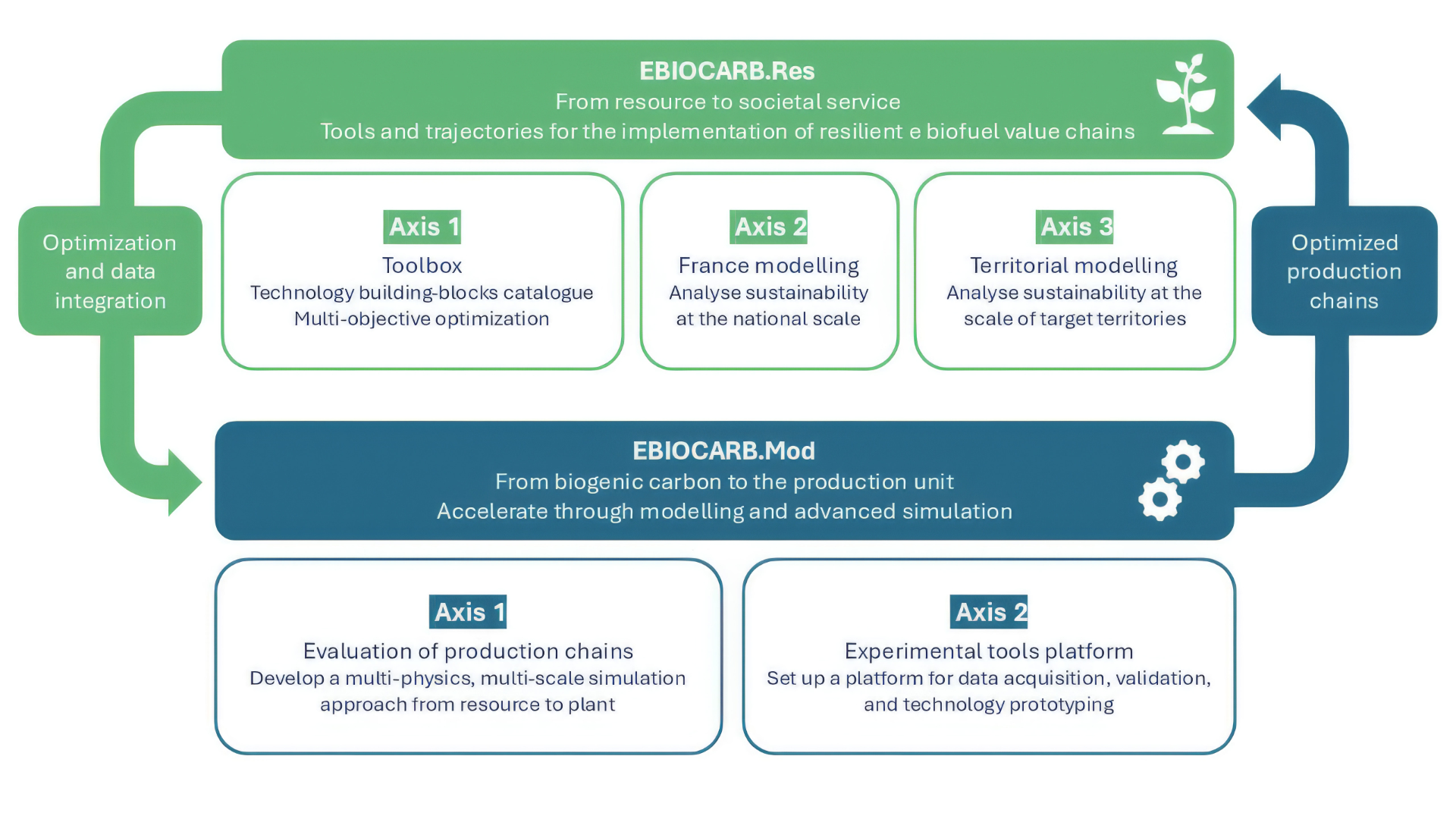
The program is structured around two complementary targeted projects:
- First project develops decision‑support tools to identify the most relevant pathways for the territorial deployment of future value chains, integrating environmental, economic and societal dimensions.
- Second project aims to accelerate technology development through multi‑scale modelling, experimental platforms and the validation of innovative processes capable of adapting to diverse feedstocks and the intermittency of low‑carbon energy. This approach will help bring innovations closer to industrial needs more rapidly and ease their progression to higher technology readiness levels.
This dual approach will help bring innovations closer to industrial needs more rapidly and facilitate their progression to higher technology readiness levels.
Related projects
No news