
PEPR FutuRE
Context
Fluctuations in the energy markets and current geopolitical tensions underscore the importance of achieving European energy independence and greater national energy sovereignty. To address these major challenges, it is essential to:
- Diversify our energy sources and integrate them into reliable, interconnected networks (primarily electricity and heat).
- Incorporate intervector conversion systems into energy grids (not just electrical grids) to ensure greater redundancy, flexibility, and resilience.
The essential questions that must be answered are :
- At what temporal and spatial scales is it necessary to analyse equilibrium states?
- What resources should be deployed? When, and based on what technical criteria?
- How can resources be reliably and securely managed, particularly when addressing cybersecurity issues?
- What overall optimisation criteria should be taken into account (economic, environmental)?
The PEPR FutuRE program, which has received €17 million in funding over five years, aims to address these research questions by bringing together 11 French research laboratories.
The program is structured around two targeted projects and a governance framework, designed to ensure collaboration and openness in its work with the broader socio-economic community.
Main objectives
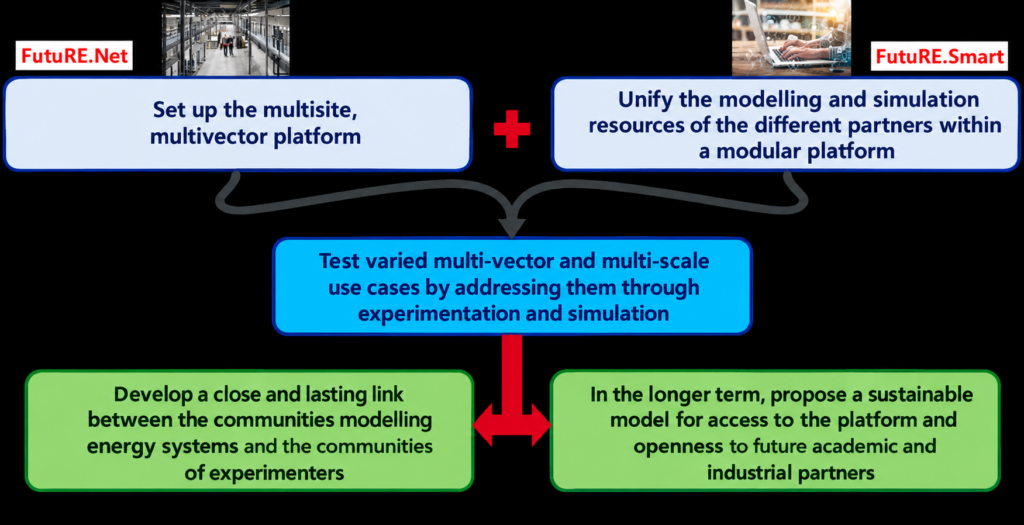
- Establish a single, multi-site, multi-vector platform by interconnecting and enhancing the existing energy platforms at academic partner institutions to increase their interoperability.
- Unify and harmonise modeling and simulation capabilities within a modular, interoperable, and scalable digital platform.
- Test a variety of multi-vector and multi-scale use cases by applying protocols that combine physical experimentation and numerical simulation.
- Analyse complex situations (network resilience, blackout risks, cyberattacks, etc.) and therefore anticipate the energy trajectories of systems at various scales through experimentation and modeling.
- Strengthen and sustain the ties between modeling and experimental communities and support interdisciplinary training (providing funding for 20 PhD students and 12 postdoctoral researchers).
Organisation
The program is structured around two targeted projects, alongside a governance framework, designed to ensure collaboration and openness in the work with the broader socio-economic community.
Related projects

No news